




Lot n° 139
Estimation :
20000 - 30000
EUR
Result with fees
Result
: 77 280EUR
Francesco Fabj-Altini (1830-1906) ou Fabi-Altini, d'après Gi - Lot 139
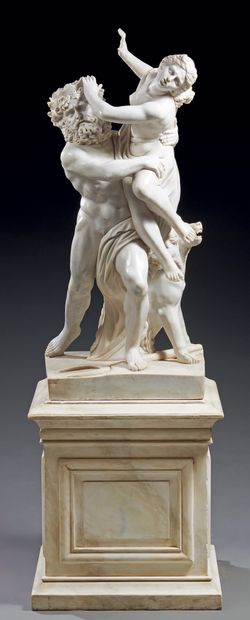
Francesco Fabj-Altini (1830-1906) ou Fabi-Altini, d'après Giambologna (1529-1608) et Gian Lorenzo Bernini (1598-1680), Italie, Rome, vers 1896
Abduction of a Sabine
Abduction of Proserpine
Two marble groups; on painted wooden pedestals.
the Abduction of Proserpine signed, located and dated: F. FABJ ALTINI/ROMA 1896
H. (groups) 140 and 132 cm
H (pedestals) 74 and 88 cm
(Some restorations).
Bibliographical references:
A. Panzetta, Dizionario degli Scultori italiani dell'Ottocento, Torino, 1994, vol. I, pp. 119-120, vol. II, ill. 329 and 330;
L. Giordani, "Francesco Fabj Altini. Il modello della Susanna di Villa Maruffi nel catalogo delle sue opere," in Villa Maruffi Materiali e Studi, no. 5, Rome, 2018.
Fabj-Altini, was a leading figure in Italian artistic institutions in the second half of the nineteenth century, enjoying the recognition of his peers. This is evidenced by the presence of his marbles of Susanna and a Putto with a lyre in the collections of the Galleria Nazionale d'Arte Moderna e Contemporanea (Rome). He was also a sculptor of international renown, exhibiting twice in London: a marble of Galatea at the Grosvenor Gallery in 1880 and another of David at the Royal Academy in 1881.
Fabj-Altini began his apprenticeship in Rome, at the Accademia di Belle Arti and then at the Accademia di San Luca, under the guidance of Adamo Tadolini (1788-1868), the talented pupil of Antonio Canova. Around 1849-50, he completed his training in the workshop of Pietro Tenerani, a distinguished pupil of Bertel Thorvaldsen. These two pivotal masters between neoclassicism and romanticism had a decisive influence on Fabj-Altini's work. In 1850, he had his first significant success with a group depicting Love and Mercury acquired by the Empress of Austria (Imperial Palace, Vienna). Among his Roman works are the funeral monuments of Cardinal Bianchi (around 1856-1864, church of San Gregorio al Celio) and of Cardinal Bafondi (church of Santa Maria in Campitelli). Following a successful competition, Fabj-Altini also created the monumental figures of the Meditation and the Prayer, two of the four allegories adorning the entrance to the Roman cemetery of Campo Verano.
His flourishing Roman workshop exported marbles to the most distant collections, as attested by a group of Adam and Eve before the fall, titled Ante Peccatum, in the Montalvo Arts Center (Saratoga, California), another of the Month of May in Peru (Alameda de los Descalzones Gardens, Lima) and another depicting Dante's Beatrice in the Hungarian National Museum (Budapest; current location unknown).
The two groups paired here are compositions of two masterpieces of the Florentine Mannerist Renaissance and the Roman Baroque, key features of the Grand Tour and sought-after models by collectors. Another larger marble of the Abduction of Proserpine by Fabj-Altini after Bernini, dating from 1898, was sold in 2004 (Finarte, Milan, 16 December 2004, lot 520, sold for 20,000). The two marbles he exhibited in London in the early 1880s, the Grosvenor Gallery Galatea and the Royal Academy David (no. 1441), were both sold by Christie's in London (the former, 28 October 1999, lot 397, sold for 78,326; the latter, 17 March 1994, lot 243, sold for 112,507).
My orders
Sale information
Sales conditions
Return to catalogue